Fulfillment Insights for
Supplement, Beauty & Wellness Brands
Operational Strategies and 3PL Expertise for Modern Health and Wellness Brands Scaling DTC, Retail, and Wholesale Operations
Key Takeaways
- Prep is now yours. Sellers or their partners handle prep and item labeling for US FBA inventory.
- Approval runs through TIC. An Amazon-authorized testing provider submits documents for each notified ASIN.
- Claims trigger deactivation. Disease claims, the FDA logo, and drug-like names are prohibited.
- Dates drive supplement prep. Expiration dates go on every unit and the outer box.
Since January 1, 2026, Amazon no longer prepares or labels inventory for FBA shipments in the US store, which changes the answer to “how to sell supplements on Amazon.”
The change, posted in Amazon’s Selling Partner API changelog, covers inventory sent directly to FBA and inventory routed into FBA through Amazon Warehousing and Distribution (AWD), Amazon Global Logistics (AGL), Amazon SEND, and the Supply Chain Portal.
Prep requirements still apply, though. Sellers are now responsible for meeting them. For anyone selling supplements on Amazon, that means meeting two separate sets of requirements: Amazon’s product and documentation rules to get the listing approved, and its packaging and labeling rules to get inventory accepted at an FBA fulfillment center.
Can You Sell Supplements on Amazon?
The short answer is yes, within Amazon’s dietary supplements policy. It requires compliance with FDA rules, including 21 CFR 101 for labeling and 21 CFR 111 or 117 for cGMP.
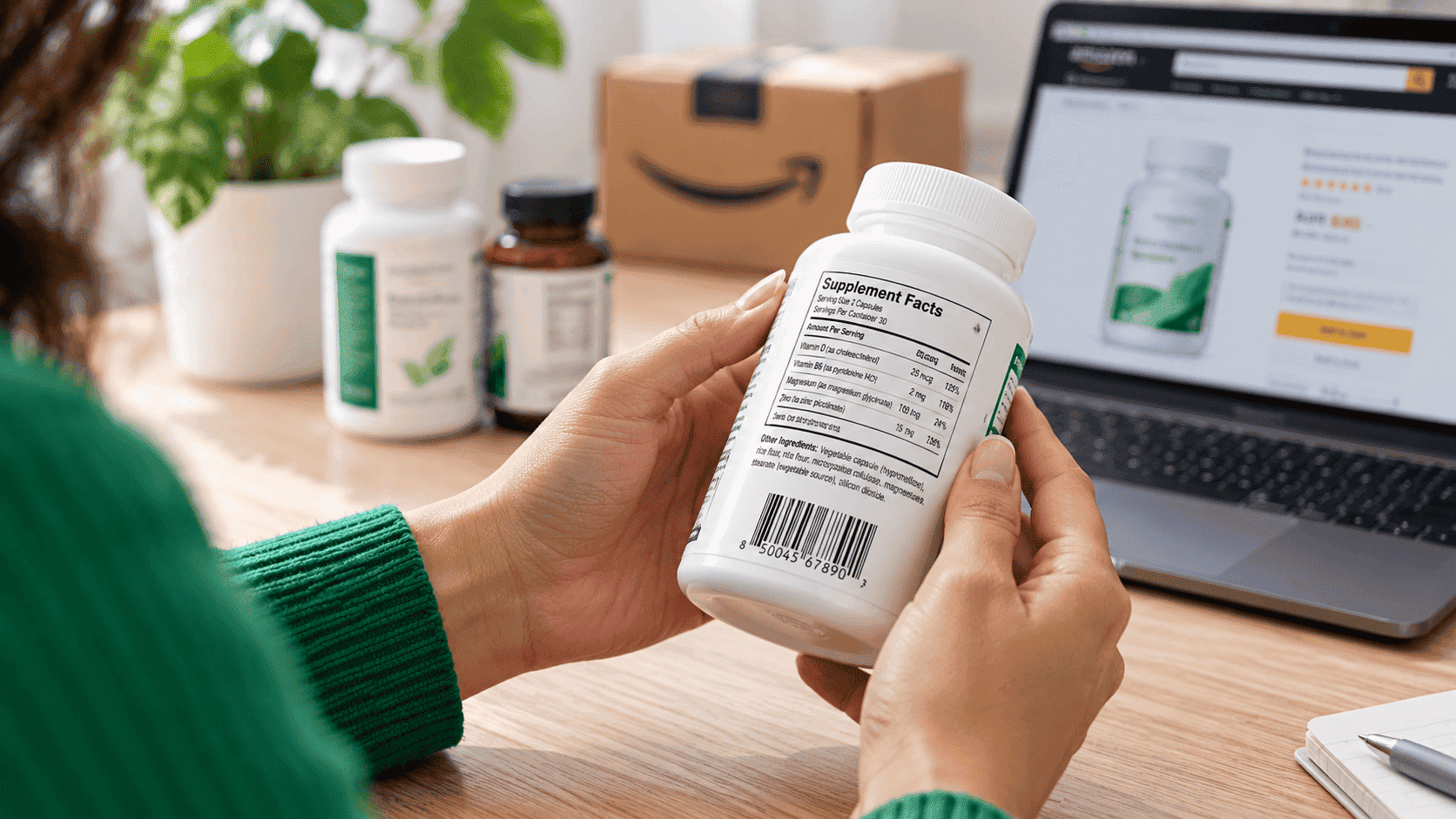
Amazon looks at both the label and the listing to decide whether a product falls under its supplement rules. A Supplement Facts panel, dosage instructions, or a claim about how the product supports the body’s structure or function can each trigger those requirements.
Certain products are prohibited altogether, including CBD, peptides such as BPC-157, GLP-1 receptor agonists, pure powdered caffeine, and supplements identified in an FDA recall or warning letter.
Brands planning to sell supplements on Amazon should check these restrictions when developing their business plan. Confirming eligibility early helps avoid preparing a launch for a product Amazon will not accept.
How to Get Approved to Sell Supplements on Amazon
Approval isn’t a form submitted to Amazon. It’s third-party verification, applied to every ASIN Amazon notifies, plus a Certificate of Insurance verified in Seller Central. Here’s what you need to do:
Build a Compliant Detail Page
The listing needs the item name, manufacturer, brand, ingredients list, and unit count. Images must show the full English label, the Supplement Facts panel, warnings, lot numbers or matrix codes, and the manufacturer’s or brand owner’s name and address.
Claims are where listings fail. Amazon prohibits disease claims, “FDA approved” claims, the FDA logo, disease names in keywords, and names that could be confused with prescription drugs, including “GLP-1.”
Verify Through an Authorized TIC Provider
Sellers work with a testing, inspection, and certification (TIC) provider authorized by Amazon, which submits documents on the seller’s behalf. Existing documents can be validated, or the product goes in for new testing.
Every supplement needs a cGMP audit or certification from an accredited third party. Private, first-party, and consulting audits don’t qualify, and neither do FDA inspections.
Bodybuilding, joint health, sexual enhancement, sports nutrition, and weight management products also need testing for heavy metals, microbes, label-claim amounts, and adulterants under NSF/ANSI 173-2024.
Bundles need separate documents and images for each product, which matters for brands using kitting and bundling to build Amazon offers.
What Supplement Prep Involves Now
Under Amazon’s product packaging requirements, non-compliant inventory can be refused, returned, or repackaged at the seller’s expense. Shipments created after January 1, 2026 without proper prep and labeling also lose reimbursement eligibility if damaged or untraceable.
The core rules are:
| Prep area | Requirement |
|---|---|
| Unit barcode | One scannable barcode per unit, off curves and corners, other barcodes covered |
| Label stock | Black ink on white, non-reflective labels with removable adhesive, 1 x 2 inches to 2 x 3 inches |
| Bagging | Plastic at least 1.5 mil thick (0.0015 inches, about 0.04 mm), fully sealed, clear or with the barcode on the outside, and extending no more than 3 inches past the product’s edges |
| Suffocation warning | Required on bags with a 5-inch or larger opening, measured flat |
| Powders | Bagged if the product spills during a vigorous shake test |
| Case packs | Same SKU and condition, equal quantities, manufacturer-packed, 150 units maximum |
Remember: If a unit can’t be scanned, kept with its set, and dated at check-in, it isn’t prepped.
Questions to Ask Before You Outsource Prep
For many brands, the right time to outsource is when labeling and carton work start pulling the team away from growth. Here are some good questions to ask before you choose a 3PL:
- How are FNSKU labels applied over existing UPC barcodes, and how is each unit checked?
- How are lot numbers and best-by dates tracked, and can a specific lot ship to Amazon?
- What gets inspected when inventory arrives from a supplier?
- Are cartons forwarded palletized, loose, and by small parcel, and who produces the shipping labels?
- Does Amazon prep run from the same inventory pool as DTC pick and pack?
Hand Off FBA Prep Without Losing Control of Lots and Dates
Doing prep in-house means owning every label, date, and carton Amazon scans. Outsourcing moves that work to an operation built for it.
NDN Fulfillment handles FNSKU labeling over existing barcodes, kitting and bundling, inserts, inbound QA inspection, and lot and best-by control. Prepped cartons are forwarded to Amazon palletized, loose, or as small parcel, with shipping labels produced by NDN.
That’s the difference between a generic prep line and supplement fulfillment built for CPG brands. Use the Fulfillment Fees Calculator to review your current setup and check usual 3PL rates.
FAQs About How to Sell Supplements on Amazon
Can I sell supplements on Amazon without Brand Registry?
Yes. Sellers without the brand representative role in Brand Registry can list supplements that meet Amazon’s policy. Since March 31, 2026, though, they must apply Amazon barcodes to every unit, even when a manufacturer UPC is printed.
How much shelf life does a supplement need at FBA check-in?
Enough to be consumed in full, plus 90 days. Under that rule, a 60-serving bottle taken once daily needs 150 days remaining. Amazon’s guideline table also lists 730 days for herbal or mineral supplements, so check both.
What happens if a supplement fails Amazon's testing?
The listing is deactivated right away. It stays deactivated until compliant documents reach Amazon and all other issues for the ASIN are resolved. Sellers can review open issues in Account Health and in Manage All Inventory.
Do supplement bundles need separate compliance documents?
Yes. Amazon requires separate documents and images for each product included in a set or bundle. At the prep stage, the bundle also needs a “Sold as set” label so its units aren’t separated at the fulfillment center.
Get Started
Use our Fulfillment Fees Calculator to evaluate your current fulfillment structure and identify operational gaps that may impact retail and wholesale growth.
If you’re evaluating B2B fulfillment partners, request a quote to see how your operation can be structured to support retailer compliance, inventory visibility, and scalable fulfillment execution.
Recent Posts