Operational Strategies and 3PL Expertise for Modern Health and Wellness Brands Scaling DTC, Retail, and Wholesale Operations
As brands grow, fulfillment doesn’t just get busier. It becomes more complex in ways that aren’t always obvious.
At early stages, operations are relatively simple.
You’re working with a limited number of SKUs, a single sales channel, and a manageable order volume. Issues happen, but they’re visible and fixable in real time.
As the business scales, that simplicity disappears.
New products are introduced. Sales channels expand. Order volume increases. Packaging variations, promotions, and edge cases start to layer in.
What used to be a linear process becomes a system with multiple dependencies across inventory, orders, and fulfillment workflows.
The challenge is that most fulfillment operations aren’t designed as systems from the beginning. They evolve reactively, built around immediate needs rather than long-term scalability.
Processes are added to solve specific problems. Tools are introduced to fill gaps. Workarounds become part of the workflow.
Over time, this creates an operation that functions, but isn’t structurally sound.
At lower volume, that fragility is hidden.
At scale, it gets exposed.
“Most fulfillment issues aren’t operational. They’re structural. If the system isn’t built for scale, growth will expose it.” — Steven Anderson, CEO, NDN Fulfillment
The breaking point isn’t volume. It’s visibility.
As complexity increases, it becomes harder to maintain a clear, accurate view of what’s happening across the operation.
Inventory is moving across locations. Orders are flowing through multiple systems. Data is being updated at different points in the process.
Without systems designed to maintain real-time accuracy, that visibility starts to degrade.
According to DHL’s Logistics Trend Radar 7.0 report,
“Today, companies have limited visibility of products as they move through production processes and supply chains.”
This limitation becomes more significant as operations scale.
At lower volume, teams can compensate for gaps in visibility. They rely on manual checks, direct communication, and institutional knowledge to stay aligned.
At higher volume, that approach breaks down.
Information becomes delayed or inconsistent. Teams are working off different data. Problems aren’t identified until they’ve already impacted the customer.
At that point, fulfillment shifts from being controlled to being reactive.
Instead of preventing issues, teams are responding to them after the fact.
What makes this challenging isn’t a single failure. It’s how quickly small issues cascade through the system.
A delay at one point in the process doesn’t stay isolated.
A late inbound shipment affects available inventory.
That inventory gap impacts order fulfillment.
Orders are delayed or split.
Customer expectations aren’t met.
Support tickets increase.
Internal teams shift focus to resolution instead of execution.
Each step creates additional pressure on the system. And without clear ownership or system-level controls, that pressure has nowhere to go.
As volume increases, the frequency of these issues increases as well. Without structured processes and clear visibility, there’s no mechanism to absorb or correct them efficiently.
This is where many 3PL relationships start to strain.
Not because of a single breakdown, but because the system lacks the resilience to handle sustained complexity.
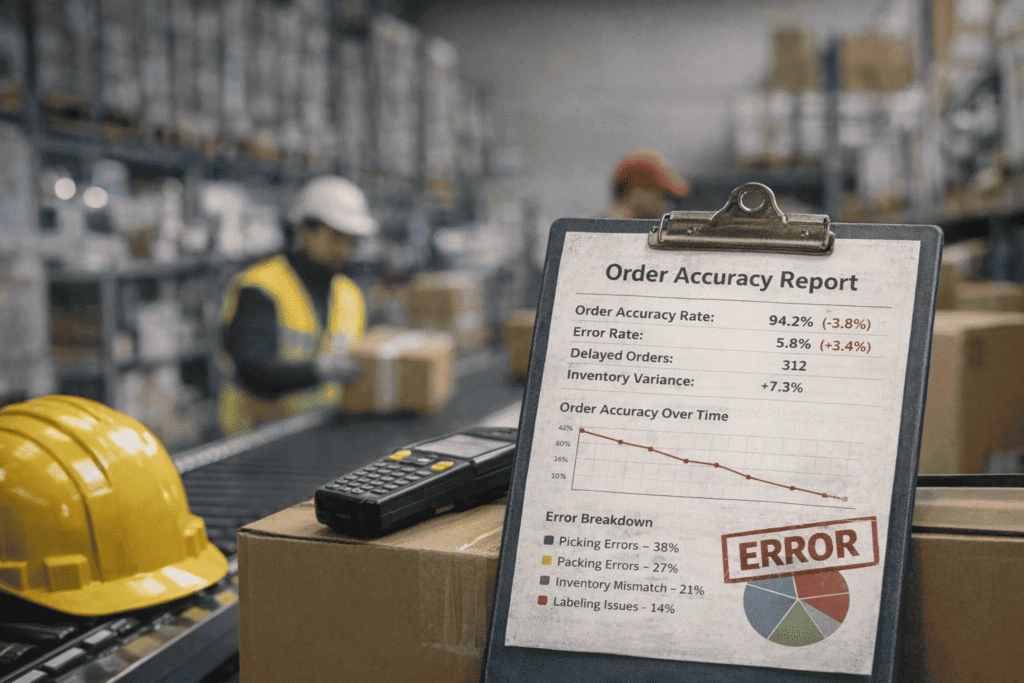
At that stage, performance becomes inconsistent.
Accuracy declines.
Lead times extend.
And the overall operation becomes harder to manage.
The impact is gradual at first, but over time it compounds into measurable business consequences.
Most 3PLs don’t fail because they lack effort. They fail because they weren’t built to handle increasing complexity.
At lower volumes, many operations appear to perform well. Orders go out. Inventory seems accurate. Communication is manageable.
But those outcomes are often supported by manual intervention, workarounds, and team effort behind the scenes.
As volume increases, that model stops working.
The underlying structure gets tested.
And in most cases, it doesn’t hold.
At scale, fulfillment becomes a data problem as much as an operational one.
Inventory needs to be tracked across locations, batches, and channels. Orders need to be processed with accuracy and speed across varying conditions.
If the underlying systems aren’t designed to handle that level of complexity, gaps start to appear.
Inventory counts drift.
Data becomes inconsistent across platforms.
Reporting loses reliability.
Without real-time, accurate data, decision-making slows down and errors increase.
At that point, the operation is no longer predictable.
In many 3PL environments, processes evolve around individuals rather than systems.
At lower volumes, experienced team members compensate for gaps. They know how to handle exceptions, resolve issues, and keep operations moving.
As volume grows, that reliance becomes a liability.
Execution becomes inconsistent.
Training becomes more difficult.
Outcomes depend on who is working, not how the system is designed.
This is where breakdown starts to show up in execution.
“The first thing that breaks at scale isn’t speed. It’s consistency. Once that slips, everything downstream gets harder to manage.” — Logan Anderson, Fulfillment Operations Manager, NDN Fulfillment
As operations expand, the number of touchpoints increases.
More orders, more exceptions, more coordination between teams.
If communication isn’t structured and responsive, delays start to build.
Issues take longer to identify.
Resolution times increase.
Accountability becomes less clear.
What used to be a manageable workflow turns into a backlog of unresolved problems.
Over time, this impacts both internal teams and the customer experience.
At scale, even small inefficiencies are amplified.
A low error rate at 500 orders per month may be manageable.
At 10,000 orders, the same error rate creates a significant volume of issues.
Picking errors increase.
Packing inconsistencies become more visible.
Returns and replacements begin to rise.
Without systems designed for accuracy at scale, maintaining consistency becomes difficult.
And consistency is what protects customer experience.
Not all fulfillment is the same.
Supplement, beauty, and health & wellness brands introduce additional complexity. This is especially true for brands in regulated or high-touch CPG categories, where operational precision is critical:
Many 3PLs are built for general merchandise. They can handle volume, but not necessarily the specific requirements of regulated or high-touch products.
As a result, issues emerge that aren’t just operational. They carry risk:
One of the most overlooked risks isn’t choosing the wrong 3PL.
It’s outgrowing the one you have.
At first, the relationship works.
The provider meets current needs. Performance is acceptable.
But as the business grows, the gaps start to widen.
Capacity gets stretched.
Processes struggle to keep up.
Service levels become inconsistent.
At that point, brands are forced into a difficult position.
Switching providers isn’t simple.
It involves:
All while maintaining customer expectations.
These transitions are rarely seamless.
They introduce risk at the exact moment the business is trying to scale.
Because of that, many brands delay making a change.
And the longer they wait, the more complex the transition becomes.
Not all 3PLs are designed to scale. But the ones that are share a consistent set of characteristics.
At a certain stage, fulfillment stops being about executing tasks and starts being about operating a system.
A scalable 3PL is built with that in mind from the beginning.
In a scalable environment, execution isn’t dependent on individuals.
Processes are defined, documented, and supported by systems that ensure consistency.
Orders move through standardized workflows.
Inventory is tracked in real time.
Data is centralized and reliable.
This creates predictability.
And predictability is what allows operations to scale without breaking.
As complexity increases, visibility becomes more important, not less.
A scalable 3PL provides clear insight into:
At scale, consistency matters.
But so does the ability to handle variation.
A strong 3PL doesn’t rely on ad hoc problem-solving. It builds structured processes that can handle:
Accuracy doesn’t happen by chance.
It’s the result of:
A scalable 3PL builds accuracy into the process itself.
That’s what allows performance to remain consistent even as order volume increases.
Not all products create the same operational demands.
For supplement, beauty, and CPG brands, fulfillment requires additional layers of control.
That includes:
A scalable partner understands these requirements and builds processes around them.
Without that expertise, risk increases as the operation grows.
Scaling isn’t just about handling more orders.
It’s about handling more complexity without adding friction.
A scalable 3PL has the infrastructure to support:
This reduces the need for constant restructuring as the business grows.
This becomes especially important as brands expand into platforms like Amazon, TikTok Shop, and other high-volume channels.
One of the biggest sources of friction in scaling operations is the disconnect between production and distribution.
When manufacturing and fulfillment operate independently, delays and misalignment are common.
Inventory takes longer to move.
Communication gaps increase.
Visibility becomes fragmented.
An integrated approach reduces these points of friction.
It creates:
Most brands evaluate a 3PL based on current needs.
That’s where mistakes happen.
The better approach is to evaluate based on where the business is going.
Can this partner handle 2–3x our current volume?
What systems are in place to manage complexity?
How is inventory tracked and validated?
What happens when something goes wrong?
How are errors identified and resolved?
What experience do they have with our product category?
You’re not just evaluating capability.
You’re evaluating whether the system holds under pressure.
Whether the operation is built to:
Most 3PLs don’t fail immediately.
They fail when the system is pushed beyond what it was built to handle.
And by the time that happens, the impact is already showing up across the business.
In customer experience.
In operational performance.
In the ability to scale.
The difference isn’t whether a 3PL can fulfill orders today.
It’s whether the system behind it can support where the business is going.
Use our Fulfillment Fees Calculator to understand how your current operation compares and where inefficiencies may be limiting your growth.
If you’re evaluating partners, request a quote to see how your fulfillment can be structured to support scale without adding complexity.